 Luxe Themes
6 Best Substack Alternatives, Honestly Compared
The six real Substack alternatives — Ghost, beehiiv, Buttondown, Kit, WordPress, Medium — compared by fees, ownership, and design, with a pick for each case.
Quick answer: The best Substack alternative for most writers is Ghost — 0% revenue cut, your own Stripe account, a real website with full design and SEO control. beehiiv is the pick for a free start and aggressive growth, Buttondown for minimalists, Kit for automation-driven creators, WordPress if you want to assemble your own stack, and Medium only if reach matters more than owning a list. Details and a decision guide below.
Fees and plans verified August 2026 — always confirm current figures on each platform’s pricing page.
Why Writers Look for a Way Out
Substack made starting a newsletter effortless, and for that job it’s still excellent. The reasons writers eventually leave are just as consistent:
The fee never graduates. Substack takes 10% of every paid subscription, plus Stripe’s ~2.9% + $0.30 processing — roughly 13% of gross revenue. A writer earning $100,000 a year hands over about $13,000, every year, for the same service a flat-fee platform provides for a few hundred dollars. And since September 2025, iOS subscriptions run through Apple’s in-app purchase, where Apple’s 30% cut (15% after year one) stacks on top — the combined take can approach 40%, and those Apple-billed subscribers never appear in your Stripe account.
Every publication looks the same. You get a logo, an accent color, and a yourname.substack.com URL. There is no theme system, no custom meta tags, no structured data, no redirects — weak foundations for anyone trying to build a brand or rank in search.
The platform keeps making the news. Every time a Substack controversy flares, writers who’d rather not have their business tied to the platform’s editorial choices start shopping for the exits. If you’re reading this during one of those weeks, you’re not alone.
None of this makes Substack useless — its discovery network genuinely finds readers for writers starting from zero. It means the platform you start on and the platform you build a business on are often two different platforms.
How to Choose
Three questions sort the alternatives:
- Do you charge (or plan to charge) readers? Then the fee model dominates everything else. 10% of revenue versus a flat fee is thousands of dollars a year once you’re earning.
- Do you want a website, or just email? A publishing platform turns every issue into a permanent, search-indexable page. An email tool leaves your archive trapped in inboxes.
- Who owns the audience? Exportable lists and payments in your own Stripe account make a platform replaceable. Platform-held billing makes leaving expensive — that’s the trap you’re currently escaping.
The Alternatives at a Glance
| Platform | Paid-sub cut | Free tier | Website included? | Best for |
|---|---|---|---|---|
| Ghost | 0% (flat fee, own Stripe) | No hosted free tier (open-source self-host) | Yes — full site, themes, SEO | Paid newsletters and publications |
| beehiiv | 0% (paid plans) | Free to 2,500 subs | Hosted publication | Growth mechanics + ad revenue |
| Buttondown | 0% ($9/mo add-on) | Free to 100 subs | No | Minimalist writers with a site |
| Kit (ConvertKit) | n/a — email-only | Free to 10,000 subs | No | Automation-heavy creators |
| WordPress + plugins | 0% (assemble your own stack) | Software is free; hosting isn’t | Yes — anything, with work | Maximum flexibility, DIY |
| Medium | n/a — no email list | Free | Hosted profile | Reach without list-building |
Ghost — The Closest Match, Without the Cut
Ghost is the alternative that maps one-to-one onto what Substack actually does: write a post, publish it as a web page and an email simultaneously, charge readers for premium access. The differences are structural. Ghost is open-source, run by a non-profit foundation, and charges a flat fee — Ghost(Pro) Publisher is $29/month with paid memberships, unlimited email sends, and a free custom domain. Payments connect directly to your own Stripe account, so Ghost takes 0% and every subscriber remains yours if you ever leave again.
The break-even math is simple: at $5/month pricing, Substack’s cut passes Ghost’s flat fee at roughly 60 paid subscribers. Beyond that, every new subscriber widens the gap — our full Ghost vs Substack comparison walks through the numbers.
The other half of the story is what a Substack can never be: a publication with its own identity. Ghost’s theme system controls the entire reader experience — typography, layouts, dark mode, membership pages — and its SEO toolkit (custom meta, canonical URLs, structured data, sitemaps) turns evergreen posts into a compounding search asset instead of an inbox-only archive.
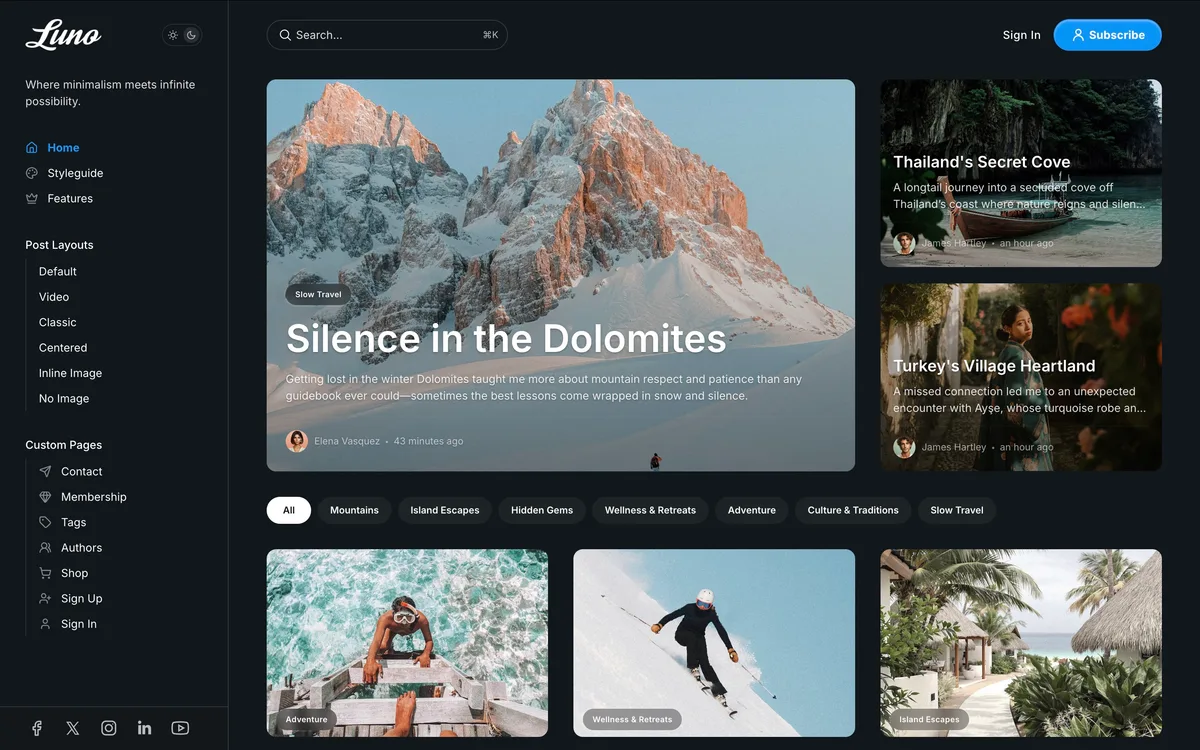
The honest trade-offs: no hosted free tier (Starter is $15/month billed annually, and paid memberships require Publisher at $29), and no discovery network — growth comes from search, social, and recommendations you build yourself.
Choose Ghost if you have or want paying subscribers, care what your publication looks like, or write evergreen content that should rank. Migration is an afternoon with the built-in importer — our Substack to Ghost migration guide covers posts, subscribers, paid members, and redirects step by step.
beehiiv — Free Start, Growth Machinery
Built by ex-Morning Brew people, beehiiv is the strongest pure growth toolkit on this list: a built-in ad network with brand advertisers, the Boosts marketplace for paid subscriber acquisition, referral programs, and cross-newsletter recommendations. The free Launch plan covers 2,500 subscribers, and paid plans (Scale, from around $43/month) take 0% of subscription revenue.
The trade-offs mirror Substack’s: a proprietary, VC-backed platform, publications that share a family resemblance, and limited SEO control. You escape the 10% cut but not the platform dependence. Full head-to-heads: Ghost vs beehiiv and Substack vs beehiiv.
Choose beehiiv if growing a large free list fast — and monetizing it with ads as much as subscriptions — is the plan.
Buttondown — The Minimalist Option
Buttondown is a deliberately small, indie-built tool: Markdown-first writing, a clean sending pipeline, an API, no feed, no network. It’s free up to 100 subscribers, paid subscriptions arrive as a $9/month add-on, and the platform takes 0% of revenue.
What it doesn’t give you is a website — there’s a hosted archive, but nothing you’d call a publication. Writers pair it with an existing site, at which point the combined cost and maintenance often argues for one platform doing both jobs; the math is in Ghost vs Buttondown.
Choose Buttondown if you already have a website you love and want the simplest possible email tool beside it.
Kit (ConvertKit) — For Automation-Driven Businesses
Kit is a different animal: an email marketing platform, not a publishing platform. Its visual automation builder — branching sequences, behavioral tagging, funnels — is the best here, and the free plan covers up to 10,000 subscribers. But there’s no website, pricing scales with list size (and rose sharply in a September 2025 price hike), and paid newsletter subscriptions aren’t the native model the way they are on Substack or Ghost.
Choose Kit if your revenue comes from product launches, courses, and funnels rather than subscription content. Comparison: Ghost vs ConvertKit.
WordPress + Newsletter Stack — Maximum Control, Maximum Assembly
You can absolutely rebuild Substack on WordPress: hosting, a membership plugin, an email plugin or external service, an SEO plugin, and a theme. The result is infinitely flexible and wholly yours. It’s also a genuine stack to assemble, secure, and update — typically 8–10 plugins and several separate bills before you’ve written a post.
For writers whose main product is the writing, that overhead is the reason Ghost exists; we’ve written the full WordPress alternative breakdown separately. But if you need e-commerce, complex page building, or functionality no publishing platform offers, WordPress is the honest answer.
Choose WordPress if the newsletter is one part of a larger site that needs capabilities beyond publishing.
Medium — Reach, Not Ownership
Medium keeps appearing on alternative lists, so let’s be precise about what it is: a network where your writing reaches Medium’s members, and the Partner Program pays you from their subscription pool based on member engagement. What it is not: a newsletter platform. You don’t own an email list, followers aren’t exportable, and your income depends on Medium’s algorithm and payout rules, which change regularly.
Choose Medium if you want distribution while building a portfolio — ideally alongside, not instead of, a list you own. More in our Medium alternative guide.
Which Should You Pick?
- Paid newsletter, now or soon → Ghost. The 0% fee and own-Stripe setup is the whole game once money flows.
- Starting from zero, need free → beehiiv (free to 2,500), then reassess when monetizing.
- Have a site, want minimal email → Buttondown.
- Selling products and courses via funnels → Kit.
- Newsletter is a feature of a bigger site → WordPress stack.
- Reach over ownership → Medium, alongside a list of your own.
- Not monetizing, love the network → staying on Substack is a defensible choice. Just keep your list exported.
Whichever you choose, apply the ownership test before committing: can you export the list, and do payments land in your Stripe account? Those two answers determine whether you’re building an asset or renting one — and they’re why this migration should be your last.
Making the Move Count
If you land on Ghost, the switch is also your one chance to relaunch. Writers who move report retention above 90%, and the ones who do best treat the migration as an upgrade announcement: a faster site, a real domain, and a design that finally looks like their publication instead of a template. Not migrating but starting fresh? How to start a newsletter with Ghost walks through the launch step by step.
That last part is where themes come in. Our best Ghost themes for newsletters round-up covers designs built for exactly this — signup-focused homepages, membership pages, dark mode, and typography that makes long-form reading a pleasure. Every Luxe theme ships with full translation support and multiple post layouts, starting at $69.
Frequently Asked Questions
What is the best Substack alternative?
What is the best Substack alternative for paid newsletters?
How do I leave Substack without losing my subscribers?
Is there a free Substack alternative?
Why are writers leaving Substack?
Keep reading
Ghost vs Substack 2026: Fees, Features & Ownership
Ghost charges 0% revenue share; Substack takes 10% plus Apple in-app fees. Newsletters, design, SEO, pricing, and ownership compared side by side for 2026.
Ghost vs Kit: Why Creators Are Leaving ConvertKit
Kit raised prices 35% and still has no website or SEO. Ghost gives you newsletters, memberships, a full CMS, and 0% revenue share for $29/mo.
Why Writers Are Switching from Medium to Ghost
Medium pays most writers under $100/mo and controls your audience. Ghost gives you 100% ownership, direct subscription revenue, and full design control.
5 Best WordPress Alternatives for Bloggers
The five real WordPress alternatives for bloggers — Ghost, static site generators, Squarespace, Webflow, Medium — compared honestly, plus when to stay put.
Recommended Themes
These themes excel at the features discussed in this article.








Comparing options? Browse all premium Ghost themes side by side.
Get every theme in one bundle
The complete Luxe Themes bundle — every theme, one purchase.