 Luxe Themes
Ghost vs Substack: Fees, Features & Ownership
Ghost charges 0% revenue share; Substack takes 10% plus Apple in-app fees. Newsletters, design, SEO, pricing, and ownership compared side by side.
Quick answer: Ghost charges 0% of subscription revenue; Substack takes 10% plus Apple’s iOS in-app fees. At 1,000 paid subscribers ($10/mo), you keep roughly $15,600/year more on Ghost. Substack wins on zero-setup simplicity and built-in discovery; Ghost wins on ownership, your own Stripe account, design control, and SEO.
The 10% Question
Substack takes 10% of every paid subscription. Add Stripe’s ~2.9% processing fee and $0.30 per transaction, and roughly 13% of your gross revenue goes to platform fees before you see a dollar.
Ghost takes 0%. You connect your own Stripe account. If a reader pays $10/month, you get $10 minus Stripe’s ~2.9%.
On a $10/month subscriber, that’s $8.41/month on Substack vs. $9.71/month on Ghost — a $1.30 difference per subscriber per month. At 1,000 paying subscribers, that’s $1,300/month ($15,600/year) you keep on Ghost that Substack would take.
Then there’s the Apple problem. In August 2025, Substack adopted Apple’s in-app purchase requirement for iOS subscriptions. Apple takes up to 30% in year one, and subscribers who pay through Apple don’t appear in your Stripe account. If you leave Substack, those Apple subscribers can’t come with you.
Revenue Comparison at Scale
At $5/month per paying subscriber, comparing Substack’s 13% combined fees vs. Ghost Publisher at $29/month:
| Paying Subscribers | Monthly Revenue | Substack Fees (13%) | Ghost Cost | Ghost Advantage |
|---|---|---|---|---|
| 50 | $250 | $32.50 | $29 | ~Even |
| 100 | $500 | $65 | $29 | +$36/mo |
| 250 | $1,250 | $162 | $29 | +$133/mo |
| 500 | $2,500 | $325 | $29 | +$296/mo |
| 1,000 | $5,000 | $650 | $29 | +$621/mo |
| 5,000 | $25,000 | $3,250 | $199 | +$3,051/mo |
The break-even point is roughly 50-60 paying subscribers at $5/month. Below that, Substack’s “free until you monetize” model costs less. Above it, every new subscriber widens Ghost’s advantage.
Newsletter Features
Both platforms have strong native newsletter capabilities. The differences are in the details.
Ghost Newsletters
- Multiple newsletters per site, each with independent subscriptions and templates
- Segmentation by newsletter subscription, membership tier, or custom label
- Publish-only, email-only, or publish-and-email modes
- Post-send link editing (update links in already-delivered emails)
- Custom sending domain on Publisher plan+ (e.g., newsletter@yourdomain.com)
- Custom email design: background colors, fonts, heading styles, button styles, header images
- Open rate and click rate analytics per post, benchmarked against your last 20 sends
Substack Newsletters
- One newsletter per publication (straightforward)
- A/B testing for subject lines (launched May 2025, boosts open rates by ~12% on average)
- Content delivered via email and the Substack app
- Platform-reported averages: 45%+ open rates, 20%+ click rates
- Minimal design customization
Ghost gives you more control and segmentation. Substack gives you a simpler setup and subject line A/B testing.
Membership and Monetization
Ghost Memberships
- Free tier, paid monthly, paid annual, and multiple premium tiers with custom pricing
- Labels for further segmentation (e.g., “founding members,” “workshop attendees”)
- Per-post content access rules: free, paid, specific tier, or email-only
- Revenue metrics: MRR, churn tracking, customer lifetime value
- Per-post conversion analytics (which posts drive free-to-paid upgrades)
- Ghost 6.0 additions (August 2025): one-time payments (tips/donations), Stripe Tax for VAT/GST, new payment methods (CashApp, iDEAL, WeChat)
All of it runs on one Stripe connection — our Ghost Stripe integration guide covers tiers, taxes, and billing setup.
Substack Memberships
- Maximum 3 tiers: Free, Paid (monthly + annual required), and Founding Member (optional premium)
- Default pricing recommendation: $5/month or $50/year
- Founding tier typically $100-500/year, same content access as paid
- Subscriber referral program with customizable rewards
- Ability to pause all paid subscriptions
Ghost offers more pricing flexibility and per-post monetization controls. Substack keeps it simple with a three-tier structure.
Design and Branding
This is where the platforms diverge most sharply.
Every Substack looks like every other Substack. Same layout, same header structure, same fonts with minor variations. You can change your accent color and upload a logo. Using a custom domain costs a one-time $50 fee and removes your publication from Substack’s Discover tab.
Ghost’s theme system is entirely different. You install a professionally designed theme and customize every visual element of your publication. Custom homepage layouts, unique typography, dark mode, reading progress bars, photo galleries — all controlled through your theme.

Our Luno theme demonstrates the gap: five hero layouts, a table of contents for long-form posts, custom membership sign-up pages, and light and dark modes, all configured without code.
For writers whose brand identity matters — and if you’re building a business around your writing, it should — the design gap alone justifies considering Ghost.
SEO Capabilities
Ghost SEO
- Custom meta titles and descriptions per post
- Auto-generated XML sitemap (linked from robots.txt)
- Canonical URLs (auto-set, overridable per post)
- Schema.org structured data on every page
- Open Graph and Twitter Card tags
- Clean semantic HTML with optimized permalinks
- Redirect management and noindex controls
Substack SEO
- Basic meta descriptions
- XML sitemaps and basic schema markup
- No canonical URL customization
- No redirect management
- No noindex controls
- Without a custom domain ($50), all SEO value accrues to substack.com
For newsletter-only publications, SEO matters less. But for writers producing evergreen content — guides, tutorials, comparison articles — Ghost’s SEO tools drive compounding organic traffic over months and years. Substack posts mostly rely on email distribution and the internal network.
Social Features
Substack Notes
Substack built a Twitter/X-like short-form feed within its ecosystem. Native comments, likes, replies. A mobile app (iOS + Android) with full functionality. An internal discovery loop where Substack’s recommendation engine surfaces your work to other readers.
The numbers are significant: 50+ million active subscriptions, 34 publications with 500K+ subscribers, 7 with 1M+ subscribers.
Ghost ActivityPub (v6.0)
Ghost 6.0 (August 2025) shipped full ActivityPub integration. Ghost publications can be followed, replied to, and shared from Mastodon, Threads, Flipboard, WordPress (with ActivityPub plugin), and other fediverse platforms.
Ghost also added “Notes” — short-form posts to the fediverse without publishing on your main site — and an “Inbox” for following other Ghost or WordPress publications.
The difference: Substack’s network is closed (Notes only exists within Substack). Ghost’s is open (connects to the broader fediverse). Substack’s is larger. Ghost’s is more open.
Data Ownership
Ghost
- You own everything: site, content, subscriber list, payment relationships
- Direct Stripe connection — the customer relationship is between you and your reader
- Full data export at any time
- Open-source — can self-host on your own infrastructure
- Free migration from Substack included with annual Ghost(Pro) plans (Ghost team handles it)
Substack
- Subscriber CSV export available
- Post export available
- Paid subscriber migration requires Stripe work (more complex)
- Without a custom domain, all search rankings belong to substack.com
- You can leave, but it’s harder than Ghost’s open-source portability
Analytics
Ghost (v6.0)
- Built-in web analytics (no Google Analytics needed for basic metrics)
- Per-post analytics: free signups and paid conversions from each post
- Conversion attribution: where on the web each new member came from
- Audience feedback: reader reactions from the bottom of emails
- Revenue dashboard: MRR, churn, customer LTV
- Growth sources tab showing subscriber origins
Substack
- Growth sources timeline (launched September 2025)
- Email metrics: open rate, views, clicks, delivery rate, 30-day rolling open rate
- Post-level table with send date, audience, and subscription conversions
- Stats categories: Network, Audience, Retention, Sharing, Notes, Email, Surveys, Traffic
- Platform-wide benchmarks: 45%+ open rates, 20%+ click rates
Both offer solid analytics. Ghost’s are more focused on conversion (which posts drive paid members). Substack’s are broader across its social features.
Pricing
Substack
Free to use. Free to publish free newsletters. When you enable paid subscriptions: 10% of gross revenue + Stripe fees (~3%). Apple in-app purchases: up to 30% additional on iOS subscriptions.
Ghost(Pro) (verified July 2026)
| Plan | Monthly (billed annually) | Members | Staff | Paid Memberships |
|---|---|---|---|---|
| Starter | $15/mo (annual) | 1,000 | 1 | No |
| Publisher | $29/mo | 1,000 | 3 | Yes |
| Business | $199/mo | 10,000 | 15 | Yes |
All plans include unlimited email sends, SSL, CDN, backups, and a free custom domain.
Self-Hosted Ghost
Open-source under MIT license. Run on a VPS from $6-12/month. Full control, zero platform fees.
Who Should Choose Substack
Substack is the right choice if:
- You’re starting from zero and need built-in discovery to find your first readers
- Substack Notes and the recommendation network are important for your growth
- You don’t plan to charge for subscriptions (Substack is genuinely free for free newsletters)
- You want zero setup friction — sign up, write, publish
- The social layer (Notes, comments, subscriber chat) fits your engagement model
Who Should Choose Ghost
Ghost is the better platform if:
- You have (or will have) paying subscribers and want to keep 100% of revenue
- Your brand identity matters — you want a publication that looks uniquely yours
- You write evergreen content that should rank in search engines
- You want multiple membership tiers with flexible pricing
- Full data ownership and the ability to self-host matter to you
- The Apple in-app purchase issue concerns you
- You want to connect to the open web via ActivityPub rather than a closed network
Curious what that looks like in practice? Our Ghost website examples roundup shows the publications running on Ghost today.
The Verdict
Substack is the easier starting point. Ghost is the better long-term platform.
If you’re a new writer with no audience and no plan to charge, Substack’s zero-cost, zero-friction model is hard to beat. The built-in discovery features help you get your first 100-1,000 subscribers faster than anywhere else.
If you’re building a publishing business — one where you charge for subscriptions, care about your brand, want SEO traffic, and plan to grow revenue over years — Ghost’s 0% fee structure, full design control, and open-source foundation make it the stronger choice.
The writers who’ve already switched (Alison Roman, FreeCodeCamp, and many more) tend to share the same reason: they outgrew what Substack offered and wanted to own their platform.
Making Your Ghost Site Stand Out
If you choose Ghost, the practical next step is design. Ghost handles posts, members, and newsletters itself and leaves how your site looks entirely to the theme — which is the point of leaving Substack’s fixed layout in the first place.
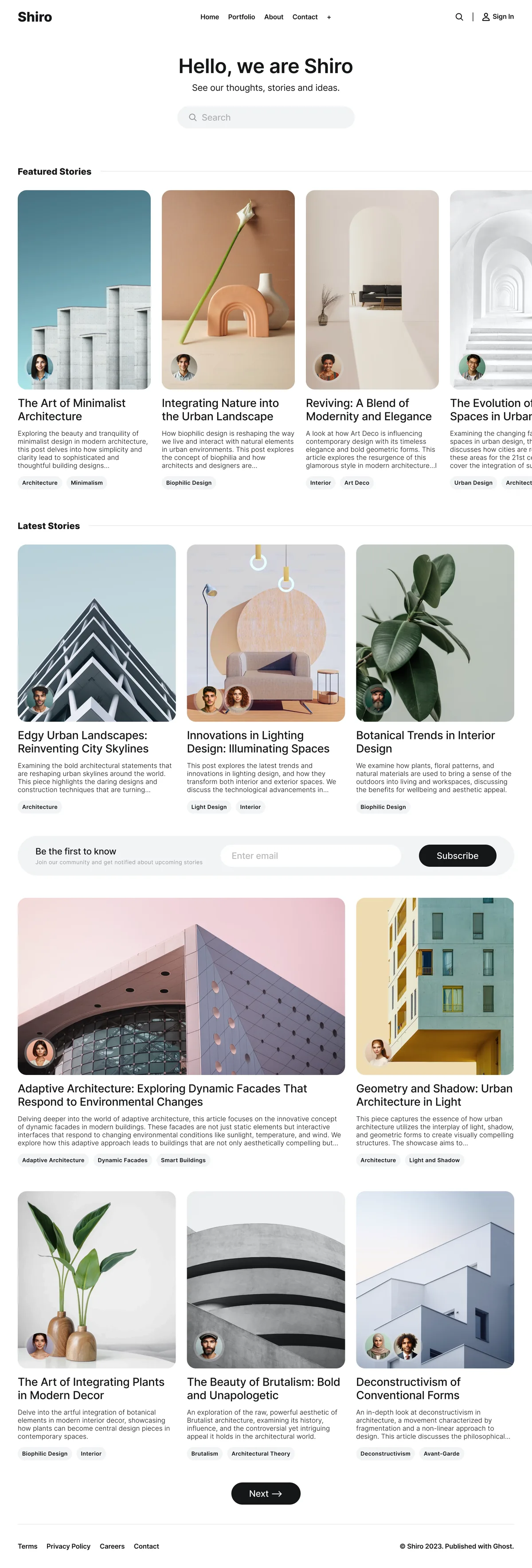
Our Ghost themes include the membership and newsletter pages that plug into the features this comparison covers, and each has a live demo you can click through before deciding.
For the full “alternative to Substack” perspective, including migration steps, see our Substack alternative guide.
Weighing Substack against beehiiv instead of Ghost? See our Substack vs beehiiv comparison.
Frequently Asked Questions
Is Ghost cheaper than Substack?
Can I move my Substack subscribers to Ghost?
Is Ghost or Substack better for SEO?
Should I choose Ghost or Substack?
Keep reading
Kit or Ghost: Email Only, or a Website Too?
Kit is an email tool; Ghost is a publishing platform with email built in. How that difference plays out in automation, SEO, design, paywalls and pricing.
Ghost vs Medium: Full Comparison for Writers
On Ghost you own your email list, set your prices and grow search traffic on your domain. Medium keeps your followers, pays from a pool and holds the rankings.
Ghost vs beehiiv: How to Actually Choose
Both take 0% of subscriptions, so it hinges on what you keep: Ghost gives ownership, design, and SEO at $29/mo; beehiiv sells growth, ads, and Boosts for $43.
Ghost vs Buttondown: Full Comparison
Buttondown is minimalist email. Ghost is email, website, and memberships in one. Compare pricing, features, and what each platform includes.
Recommended Themes
Themes with at least one of the features this guide touches: membership pages, newsletter integration, SEO optimization and dark mode.

Tribune
Strongest hereTribune is the front page of a newspaper. Lead stories beside the day's picture, a Featured list at the edge, then your sections by topic, each in its own layout, under a masthead that folds away as the reader scrolls. Built for newspapers and multi-author magazines that publish several stories a day, and managed entirely from Ghost admin.

Luno
Strongest hereLuno is a blog that works like an app. A menu that stays open in a fixed sidebar, search a keystroke away, a light and dark switch beside your logo, and a homepage that opens with three featured stories as cover cards. Built for travel, lifestyle and product blogs whose readers expect an interface they already know, and managed entirely from Ghost admin.


Comparing options? Browse all premium Ghost themes side by side.
Get every theme in one bundle
The complete Luxe Themes bundle: every theme, one purchase.