 Luxe Themes
Why Newsletter Creators Are Leaving Mailchimp
Mailchimp gutted its free plan, killed subscriptions, and keeps raising prices. Ghost offers newsletters, memberships, and a full website for $29/mo.
Quick answer: Yes, for writers and newsletter creators. Mailchimp has shrunk since Intuit acquired it in 2021, prices by contact count, and killed paid subscriptions in February 2024. Ghost bundles a full website, unlimited newsletters, and 0% memberships at a flat $29/mo. Mailchimp still fits e-commerce stores needing deep integrations and advanced automation.
Not ready to switch? You can also connect Mailchimp to Ghost with an embedded form or Zapier while you transition.
Mailchimp Isn’t the Same Company Anymore
Intuit acquired Mailchimp for $12 billion in November 2021. Since then:
- The free plan was cut from 500 contacts and 1,000 emails to 250 contacts and 500 emails per month (January 2026)
- Automations were removed from the free plan entirely
- Founder Ben Chestnut was pushed out
- Prices have risen steadily across every tier
- The digital storefront and subscription feature was shut down in February 2024 — killing any native path to paid memberships
Mailchimp still holds roughly 67% email marketing market share, but that number has been declining since 2022. The trajectory is clear: Intuit is extracting value from Mailchimp’s user base, not investing in it.
For newsletter creators who want more than a shrinking email tool, there’s a fundamentally different option.
What Mailchimp Charges Now
Mailchimp’s pricing scales by contact count, and contacts include people who’ve unsubscribed — you’re billed for contacts you can’t even email.
| Plan | Starting Price | Contact Limit | Monthly Send Limit |
|---|---|---|---|
| Free | $0 | 250 | 500 emails |
| Essentials | $13/mo | 50,000 | 10x contacts |
| Standard | $20/mo | 100,000 | 12x contacts |
| Premium | $350/mo | 200,000+ | 15x contacts |
Scaled pricing on the Standard plan: 2,500 contacts costs ~$60/month. 5,000 contacts costs ~$90/month. 10,000 contacts crosses $150/month.
And Mailchimp is only an email tool. It has a basic landing page builder, but no blog, no CMS, no website, and no way to create or sell paid memberships.
What Ghost Offers Instead
Ghost is an open-source publishing platform that combines a full website, email newsletters, and paid memberships in one system. Run by a nonprofit foundation, Ghost charges a flat hosting fee and takes 0% of your revenue.
Ghost(Pro) Publisher costs $29/month (billed annually). That includes:
- A complete website and blog with your own domain
- Unlimited email newsletter sends
- Paid memberships with direct Stripe integration (0% platform fee)
- Built-in SEO tools (sitemaps, meta tags, structured data)
- Multiple newsletters with audience segmentation
- SSL, CDN, backups, and managed hosting
At the same cost as Mailchimp’s Standard plan with 2,500 contacts ($60/month), Ghost gives you everything Mailchimp does for email delivery plus a full publishing platform and monetization tools.
The Fundamental Difference
Mailchimp is an email marketing tool. Ghost is a publishing platform. Our Ghost vs Mailchimp comparison sets out what each one includes.
Mailchimp sends emails. It doesn’t host your content. It doesn’t build your website. It doesn’t help readers find your work through search engines. It can’t create paid memberships anymore (that feature was killed in 2024). To get what Ghost includes in one platform, a Mailchimp user needs:
- Mailchimp for email ($20-150+/month depending on list size)
- WordPress or Squarespace for a website ($8-40+/month)
- Memberful or Patreon for paid memberships ($0-49+/month plus fees)
- Yoast or a similar SEO tool ($0-99/year)
That’s 3-4 separate tools with separate logins, separate billing, and no integration between subscriber data and website analytics.
Ghost unifies all of this. Write a post, choose your audience, and publish — it goes to your website and your subscribers’ inboxes in one action. Your member data, email analytics, and website traffic all live in the same dashboard.
Feature Comparison
| Feature | Ghost | Mailchimp |
|---|---|---|
| Email newsletters | Built-in, unlimited sends | Core product, send limits by plan |
| Website/blog | Full CMS included | Landing pages only (no blog/CMS) |
| Paid memberships | Native Stripe integration, 0% fee | Removed in February 2024 |
| SEO tools | Built-in (sitemaps, schema, meta) | None (emails aren’t indexed) |
| Custom domain | Included free | N/A (not a website platform) |
| Multiple newsletters | Yes, each with own subscriptions | Yes, via audience segmentation |
| Audience segmentation | By tier, label, newsletter | By tags, behavior, purchase history |
| Marketing automation | Basic (welcome emails, tiers) | Advanced (multi-step journeys) |
| A/B testing | Subject lines | Up to 8 variations (Standard+) |
| Integrations | Zapier, REST API | 300+ native integrations |
| Self-hosting | Yes (open-source, MIT) | No |
| Revenue share | 0% | N/A (no monetization) |
Where Mailchimp Still Wins
Mailchimp has genuine advantages for specific use cases:
Advanced marketing automation. Multi-step customer journeys, abandoned cart emails, behavioral triggers, purchase-path automation — Mailchimp’s automation builder is significantly more powerful than Ghost’s. If you run an e-commerce store and need complex email sequences triggered by customer behavior, Mailchimp (or a dedicated marketing automation tool) is the better fit.
Deep e-commerce integrations. 300+ native integrations including Shopify, WooCommerce, and Salesforce with purchase data syncing. Ghost connects to external tools through Zapier and its REST API, but doesn’t have the native e-commerce integration depth.
Multivariate A/B testing. Test up to 8 campaign variations simultaneously on the Standard and Premium plans — subject lines, from names, content, and send time. Ghost’s A/B testing is limited to subject lines.
Large list management at scale. Mailchimp’s Standard plan handles up to 100,000 contacts at $800/month. For organizations sending promotional emails to very large lists, Mailchimp’s infrastructure is battle-tested.
Where Ghost Wins
Your own website and brand. Ghost is a complete publishing platform. Your content lives on your domain, ranks in search engines, and looks exactly how you want it to. Mailchimp emails are ephemeral — they’re read and deleted. Ghost posts are permanent, searchable, and drive organic traffic for years.
Paid memberships with 0% platform fee. Ghost connects directly to your Stripe account. If a reader pays you $10/month, you keep $10 minus Stripe’s ~2.9% processing fee. Mailchimp removed its subscription feature entirely.
Built-in SEO. Every Ghost post generates proper meta tags, structured data, Open Graph tags, and appears in an XML sitemap. This matters because search-driven content compounds — a well-optimized post ranks and drives subscribers for years. Mailchimp emails don’t rank in search engines at all.
Nonprofit, mission-driven organization. Ghost is run by the Ghost Foundation, registered as a nonprofit in Singapore. It can’t be acquired, can’t issue stock, and reinvests 100% of revenue into the product. Mailchimp is now a division of Intuit, a publicly traded company with quarterly earnings pressure.
Predictable pricing. Ghost charges a flat rate regardless of list size (within plan limits). No surprise bills because your contact list grew. No charges for unsubscribed contacts.
The Pricing Math
For a newsletter creator with 2,500 subscribers who wants a website, newsletters, and paid memberships:
Mailchimp + WordPress + Memberful:
- Mailchimp Standard (2,500 contacts): ~$60/month
- WordPress hosting (managed): ~$30/month
- Memberful (Starter): $0 + 10% of revenue
- Total: ~$90/month + 10% of membership revenue
Ghost Publisher:
- $29/month (billed annually)
- 0% revenue share on memberships
- Total: $29/month
At 5,000 subscribers, Mailchimp alone costs ~$90/month. Ghost Publisher still costs $29/month until you exceed 1,000 members — at which point the Business plan at $199/month covers up to 10,000.
Who Should Stay with Mailchimp
Mailchimp makes sense if:
- You run an e-commerce business and need deep Shopify/WooCommerce integration
- Your email strategy relies on complex multi-step automation sequences
- You need advanced multivariate A/B testing across content, subject, and send time
- You already have a separate website and just need an email sending tool
Who Should Switch to Ghost
Ghost is the better choice if:
- You’re a writer, blogger, or newsletter creator — not an e-commerce store
- You want your content to live on a website you own, not just in email inboxes
- You want to monetize through paid memberships (Mailchimp can’t do this anymore)
- Mailchimp’s rising prices and shrinking free plan concern you
- You want one platform for publishing, email, and memberships instead of 3-4 tools
- Platform independence matters — Ghost is open-source and can be self-hosted
Making the Move
The migration process:
- Export your Mailchimp subscribers (Audience → All Contacts → Export)
- Import the CSV into Ghost via the Admin panel
- Set up your custom domain
- Install a theme and customize your brand
- Configure your newsletter design and welcome emails
- Connect Stripe for paid memberships
Ghost also has a REST API that can automate subscriber imports for larger lists.
Build Your Newsletter Brand
When you move to Ghost, your publication’s design is entirely in your hands. Unlike Mailchimp’s landing page templates, Ghost themes give you a complete website that reflects your brand.
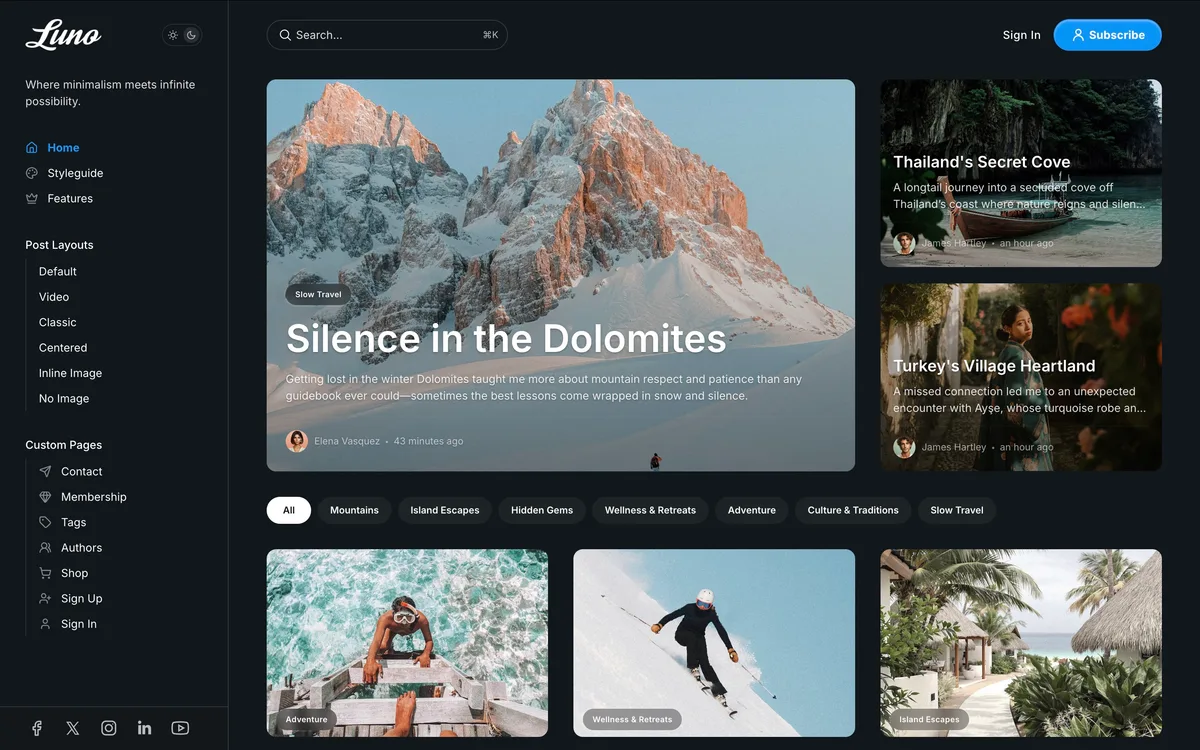
Our Luno theme includes custom membership pages, a table of contents for long-form posts, and five hero layouts, all designed for newsletter publishers who take their brand seriously.
Frequently Asked Questions
Why are newsletter creators switching from Mailchimp to Ghost?
How does Mailchimp pricing change as my contact list grows?
Is Ghost just email marketing, or a full website too?
Can I sell paid subscriptions with Ghost like I used to with Mailchimp?
Keep reading
A beehiiv Alternative: When Ghost Fits Better
Weighing a beehiiv alternative? Ghost also takes 0% of subscription revenue and adds open-source ownership and full design control, but has no ad network.
Ghost vs Kit (ConvertKit): Should You Switch?
Should you move from Kit (ConvertKit) to Ghost? What each includes, pricing since the 2025 increase, where Kit still wins, and how to move your subscriber list.
Why Writers Are Switching from Medium to Ghost
Medium pays most writers under $100/mo and controls your audience. Ghost gives you 100% ownership, direct subscription revenue, and full design control.
6 Best Substack Alternatives, Honestly Compared
Six real Substack alternatives compared by fees, ownership and design, with a pick for each case: Ghost, beehiiv, Buttondown, Kit, WordPress and Medium.
Recommended Themes
Themes with at least one of the features this guide touches: membership pages, newsletter integration, SEO optimization and dark mode.

Tribune
Strongest hereTribune is the front page of a newspaper. Lead stories beside the day's picture, a Featured list at the edge, then your sections by topic, each in its own layout, under a masthead that folds away as the reader scrolls. Built for newspapers and multi-author magazines that publish several stories a day, and managed entirely from Ghost admin.

Luno
Strongest hereLuno is a blog that works like an app. A menu that stays open in a fixed sidebar, search a keystroke away, a light and dark switch beside your logo, and a homepage that opens with three featured stories as cover cards. Built for travel, lifestyle and product blogs whose readers expect an interface they already know, and managed entirely from Ghost admin.


Comparing options? Browse all premium Ghost themes side by side.
Get every theme in one bundle
The complete Luxe Themes bundle: every theme, one purchase.