 Luxe Themes
Ghost as a Publishing Platform: Full Overview
Ghost combines a CMS, newsletter system, and membership platform into one. Here is what makes it different from WordPress, Substack, and website builders.
What Ghost Actually Is
Ghost is a publishing platform. Not a website builder, not an email tool, not a membership plugin — a platform that combines all three into one product.
This overview goes deep on the platform itself. If you’re deciding whether to use Ghost as your blogging platform, that page compares it to WordPress, Medium, and Substack and helps you pick a theme.
Founded in 2013 by John O’Nolan (former WordPress Deputy Head of UI), Ghost was built from the ground up for professional publishing. It is open-source under the MIT license and run by a nonprofit foundation that cannot be acquired, sold, or pivoted by investors.
Ghost’s core thesis: writers and publishers should not need to assemble a website builder, an email marketing service, a membership plugin, and an SEO toolkit from separate vendors. One platform should handle all of it.
The Three Pillars
1. Content Management System
Ghost’s CMS is purpose-built for writing and publishing:
The Editor (Koenig):
- Clean, distraction-free writing interface
- Dynamic content cards: images, galleries, video, audio, bookmarks, embeds, HTML, callouts, toggle sections, file downloads
- Built-in Unsplash image search (free stock photos without leaving the editor)
- Markdown shortcuts for fast formatting
- Code blocks with syntax highlighting
- Email-specific content cards (content visible only in the email version)
Content Organization:
- Posts and pages with distinct publishing workflows
- Tag-based organization with primary and secondary tags
- Author profiles with individual social links and bios
- Scheduling to specific date and time
- Multiple authors per post
Publishing Controls:
- Draft, scheduled, and published states
- Post visibility: public, members-only, paid members, specific tier
- Custom excerpts for listings and social sharing
- Featured post flagging for homepage highlights
2. Email Newsletter System
Ghost’s newsletter is not a third-party integration — it is built into the platform:
- Write a post and send it to subscribers in one action
- Multiple newsletters per site with independent subscription lists (Publisher plan+)
- Three modes: publish and email, publish only, or email only
- Segmentation by membership tier, label, or newsletter subscription
- Custom email design: fonts, colors, buttons, header images, footer content
- Post-send link editing (update links in already-delivered emails)
- Per-post analytics: open rate, click rate, individual link clicks
- Unlimited sends on all plans
The integrated workflow is what separates Ghost from “CMS + email tool” combinations. There is no content duplication, no subscriber sync, no separate platform to manage.
For a step-by-step setup guide, see how to start a newsletter with Ghost.
3. Membership and Monetization
Ghost connects directly to Stripe for paid memberships:
- 0% platform fee on all subscription revenue (only Stripe’s ~2.9% applies)
- Free, paid, and premium tiers with custom pricing
- Per-post content access rules: public, free members, paid members, specific tier
- Server-side content gating — paywalled content never reaches the browser without authentication
- One-time payments and tips (Ghost 6.0)
- Revenue dashboard: MRR, churn, customer lifetime value
- Free-to-paid conversion tracking per post
For detailed pricing, see our Ghost pricing guide.
How Ghost Compares
vs WordPress
WordPress powers 43% of the web but was not designed for modern publishing workflows. To match Ghost’s feature set, WordPress requires a hosting provider, a theme, a newsletter plugin (like Jetstep or Mailchimp integration), a membership plugin (like MemberPress or Paid Memberships Pro), and ongoing plugin maintenance.
Ghost includes all of this natively. No plugin conflicts, no security patches for third-party code, no compatibility testing between 5+ vendors.
For the full comparison, see Ghost vs WordPress.
vs Substack
Substack is a newsletter platform that takes 10% of subscription revenue. Ghost takes 0%. Substack gives you a uniform design shared by every other Substack publication. Ghost gives you complete design control through professional themes.
For the full comparison, see Ghost vs Substack.
vs Website Builders (Squarespace, Webflow)
Website builders are designed for websites that also have a blog. Ghost is designed for publications that are the website. The newsletter, membership, and SEO features are native rather than add-ons.
For specific comparisons: Ghost vs Squarespace | Ghost vs Webflow
Ghost’s Technical Architecture
Open Source (MIT License)
Ghost’s entire codebase is public on GitHub. You can inspect every line of code, contribute improvements, or fork the project. The MIT license imposes no restrictions on commercial use.
This means platform risk is structurally low. Even if Ghost(Pro) the hosting service disappeared, the software would continue to exist and be deployable by anyone.
Self-Hosting Option
Ghost can be installed on any Linux server using Ghost-CLI. A $4-6/month VPS from DigitalOcean, Vultr, or Hetzner is sufficient for most publications. Self-hosting gives you full server control and eliminates per-subscriber scaling costs, though you manage updates, backups, and email delivery (via Mailgun) yourself.
Headless CMS Capability
Ghost’s Content API enables headless usage — use Ghost as a content backend while building a custom frontend in React, Vue, Next.js, Nuxt, Astro, or any framework. The API delivers content as JSON, giving developers complete control over presentation.
ActivityPub Federation
Ghost is building native Fediverse support through ActivityPub. Your Ghost publication becomes part of the decentralized social web, discoverable on Mastodon and other ActivityPub-compatible platforms without algorithmic gatekeeping.
The Nonprofit Foundation
Ghost is owned and operated by the Ghost Foundation, a registered nonprofit. This is not a marketing label — it is a legal structure that prevents acquisition, ensures all revenue is reinvested into the product, and aligns the platform’s incentives permanently with its users.
No board of directors pressuring for quarterly revenue growth. No VC exit strategy that could pivot the product. No possibility of a Mailchimp-style acquisition that degrades the platform over time.
Who Ghost Is Built For
Newsletter publishers who want their content to live on the web and in inboxes simultaneously, with proper SEO markup driving organic traffic.
Membership-based publications that want to monetize directly through subscriber payments at 0% platform fee, with full control over tiers and pricing.
Independent writers who want to own their platform — their content, their subscriber list, their domain, and their revenue relationship — without depending on a VC-backed company that could change terms.
Content-first businesses where publishing is the product, not a marketing channel alongside an e-commerce store or service business.
Getting Started
Ghost(Pro) is the fastest path: sign up, choose a plan, and start publishing. Plans start at $15/month (annual) for Starter (free newsletter, 1,000 members) or $29/month for Publisher (paid memberships, custom themes, advanced features).
For self-hosting, Ghost-CLI installs on Ubuntu in minutes. See the Ghost pricing guide for a complete cost breakdown.
Make It Yours
The theme you choose defines your publication’s visual identity. Ghost’s theme system supports complete design customization through Handlebars templates.
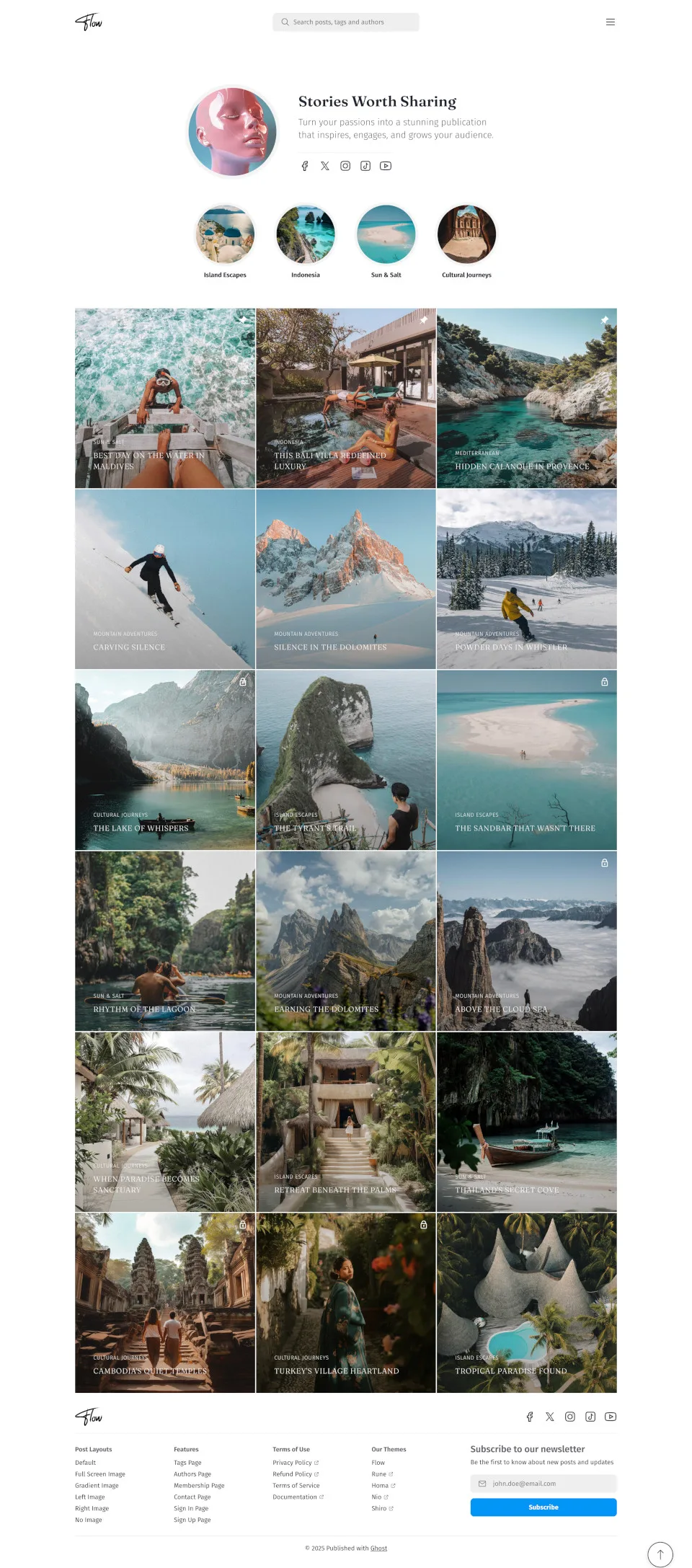
Our Flow theme shows what a publishing theme can add: a menu that slides in from the right, a highlights carousel, an add-to-home-screen app mode, dark mode and 46+ languages.
Our themes start at $69 and include everything a Ghost publisher needs.
Comparing every option? See our best blogging platforms ranking.
Frequently Asked Questions
What is Ghost?
Who is Ghost built for?
What can you build with Ghost?
Is Ghost open-source and who owns it?
Keep reading
Why Ghost Asks Subscribers to Confirm by Email
Ghost makes every new subscriber click a link before they exist on your list, and never shows the ones who did not. Why that is, and how to lose fewer of them.
Ghost Memberships: Set Up Free and Paid Tiers
How Ghost memberships work and how to set them up: free and paid tiers, connecting Stripe, gating posts and managing members. Ghost takes no cut of revenue.
Stopping Spam Signups on a Ghost Site
What spam signups do to a Ghost site, what Ghost already blocks on its own, and what to add in front of it. We tested the built-in limit on our own site.
Ghost Newsletters Without Mailgun: Real Options
Self-hosted Ghost only sends newsletters through Mailgun. What SMTP can and can't do, how Amazon SES and Postmark fit, what the proxies cost, and what to pick.
Recommended Themes
Themes with at least one of the features this guide touches: membership pages, newsletter integration, SEO optimization and dark mode.
Tribune
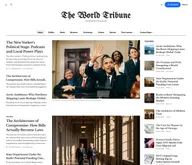
Strongest hereTribune is the front page of a newspaper. Lead stories beside the day's picture, a Featured list at the edge, then your sections by topic, each in its own layout, under a masthead that folds away as the reader scrolls. Built for newspapers and multi-author magazines that publish several stories a day, and managed entirely from Ghost admin.

Luno
Strongest hereLuno is a blog that works like an app. A menu that stays open in a fixed sidebar, search a keystroke away, a light and dark switch beside your logo, and a homepage that opens with three featured stories as cover cards. Built for travel, lifestyle and product blogs whose readers expect an interface they already know, and managed entirely from Ghost admin.


Comparing options? Browse all premium Ghost themes side by side.
Get every theme in one bundle
The complete Luxe Themes bundle: every theme, one purchase.